
How to Pay Yourself as a Business Owner: LLC vs. S-Corp
One of the most common questions we hear from small business owners in Columbia, Maryland is: "How do I actually pay myself?" The answer depends on how your business is structured — and getting it wrong can create IRS problems, payroll headaches, or unexpected tax bills.
Here's what you need to know.
LLC — Owner's Draw
If you operate as a sole proprietor or single-member LLC (or a multi-member LLC taxed as a partnership), you pay yourself through an owner's draw — a direct transfer of funds from your business account to your personal account.
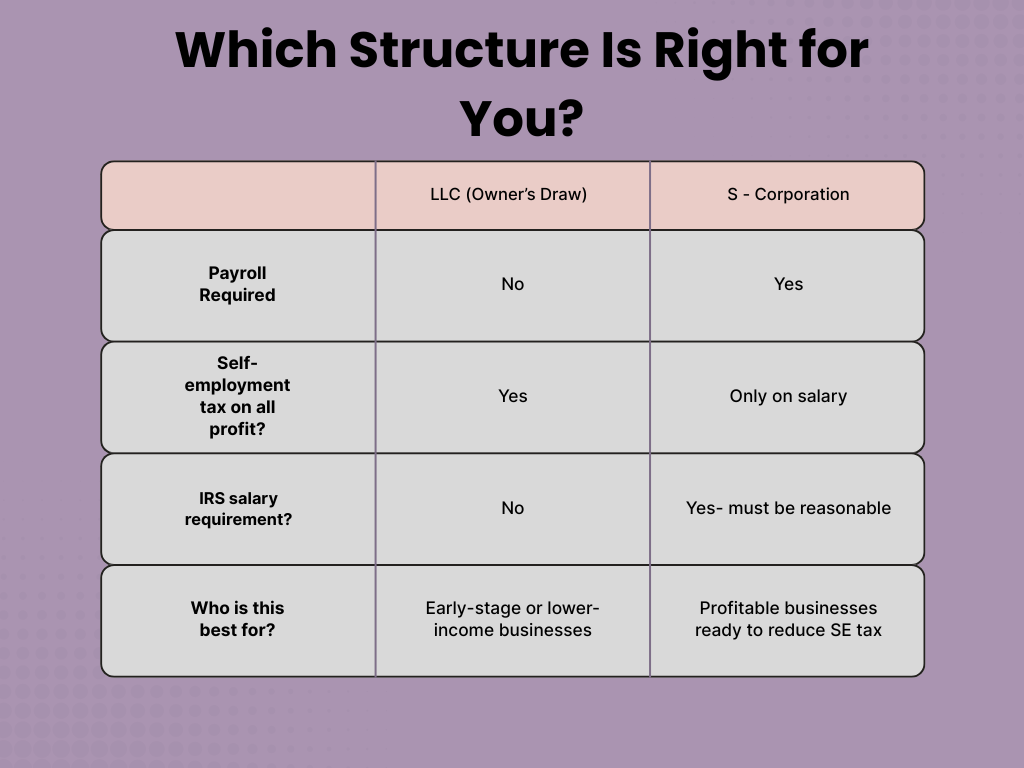
There's no payroll, no W-2, and no withholding. You simply move money out of the business when needed.
A few things to keep in mind:
Space your draws out intentionally. Don't drain the account all at once. Spreading draws throughout the year keeps your cash flow healthy and makes it easier to cover operating expenses, quarterly estimated taxes, and unexpected costs. A good rule of thumb: pay yourself consistently, like a salary, even if it's technically a draw.
Understand your industry and income. How much you draw should reflect what your business can actually sustain. Review your profit margins, seasonal patterns, and upcoming expenses before deciding on an amount. Drawing too aggressively in a slow month can leave you scrambling later.
Tax note: As an LLC owner, you pay self-employment taxes (15.3%) on your net business income — not just what you draw. This catches many new business owners off guard, which is exactly why working with a CPA from the start matters.
S-Corp — Reasonable Salary
If your LLC has elected S-Corp tax status (or you operate as an S-Corp), the rules change significantly. The IRS requires you to pay yourself a W-2 salary before taking any additional distributions.
Your salary must be "reasonable." This is where the IRS pays close attention. A reasonable salary is what you'd expect to pay someone else to do the same work in your industry. If you're a marketing consultant generating $200,000 in revenue and paying yourself $15,000 a year to minimize payroll taxes, the IRS will take notice. Industry data, job postings, and professional standards all factor into what's considered reasonable.
You must run payroll. A salary means withholding federal and Maryland income taxes, Social Security, and Medicare — and remitting them on schedule. This requires a payroll system, either in-house or through a provider. After your salary is paid, you can take additional profits as distributions, which are not subject to self-employment tax. That's the core tax advantage of S-Corp status.
Let's Talk About Your Pay Strategy
At Insightful Accounting Services, we help small business owners in Columbia, MD structure their pay the right way — minimizing taxes while staying fully compliant with IRS guidelines.