
In Part 1 of this series, we covered the retirement plans best suited to solo entrepreneurs and business owners without employees: the Traditional and Roth IRA, the Solo 401(k), and the SEP IRA. But what if your business has grown to include a team? In Part 2, we cover the two plans built to include employees — the SIMPLE IRA and the Traditional 401(k) and finish with a side-by-side comparison to help you decide which plan is the right fit.
4. SIMPLE IRA — The Right Fit When You Have Employees
What It Is
The Savings Incentive Match Plan for Employees (SIMPLE IRA) is designed for small businesses with up to 100 employees that want to offer a retirement benefit to their team without the cost and complexity of a full 401(k). It functions similarly to a 401(k), with both employee salary deferrals and a required employer contribution.
2026 Contribution Limit: Employees can defer up to $17,000 ($21,000 for those age 50 to 59 or 64 and older, and $22,250 for those age 60 to 63). Employers with 25 or fewer employees may offer a higher deferral limit of $18,100.
Pros:
Includes employees — unlike a SEP IRA, a SIMPLE IRA allows your employees to contribute from their own paychecks via salary deferral, making it a meaningful benefit you can offer your team
Higher contribution limit than an IRA — the SIMPLE IRA allows employees to save more than double the IRA limit
Employer matching builds loyalty — you're required to make one of two employer contributions: either a dollar-for-dollar match of up to 3% of employee compensation, or a flat 2% non-elective contribution for all eligible employees (even those who don't contribute). This creates a meaningful benefit for your workforce
Lower administrative cost and complexity than a traditional 401(k)
Contributions are tax-deductible for the business
No Form 5500 filing requirement
Cons:
Mandatory employer contribution — you cannot skip the employer match or contribution, even in a slow year
Must be established by October 1 of the year you want it to be effective — less flexibility than a SEP IRA when it comes to timing
Early withdrawal penalty is steeper — withdrawals within the first two years of participation are subject to a 25% penalty (vs. the standard 10%), which is important to disclose to employees
Lower employee deferral limit than a 401(k) — high-earning employees can save more in a traditional 401(k)
Cannot have another retirement plan in place — if you have a SIMPLE IRA, it must be the only plan for the year
Somewhat more setup and administration than a SEP IRA, but far less than a full 401(k)
Best For: Small businesses with a handful of W-2 employees who want to offer a retirement benefit at a reasonable cost and without the full overhead of a traditional 401(k) plan.
5. Traditional 401(k) — Built for Growth-Stage and Larger Businesses
What It Is
The traditional employer-sponsored 401(k) is the gold standard of workplace retirement plans — and for good reason. It's the most feature-rich, flexible, and powerful option available, offering high contribution limits, investment flexibility, and the ability to serve a large workforce. However, it comes with meaningful setup and ongoing administrative costs that make it better suited for businesses that have grown beyond the startup phase.
2026 Contribution Limit: Employees can defer up to $24,500 ($32,500 for age 50 to 59, and $35,750 for age 60 to 63); total contributions (employer + employee combined) up to $72,000, or $80,000/$83,250 with catch-up contributions included.
Pros:
Built for businesses with many employees — a traditional 401(k) scales with your workforce and is the expected benefit at companies with 10, 50, or 500 employees
Highest employee deferral limit of any plan — $24,500 per year (plus catch-up) allows employees to save aggressively
Employer match is discretionary — unlike a SIMPLE IRA's required contribution, traditional 401(k) employer matches are optional and can be structured however you choose (dollar-for-dollar up to a percentage, etc.)
Roth 401(k) option available — employees can choose pre-tax or after-tax deferrals
Vesting schedules — you can require employees to stay a certain number of years before employer contributions vest, which aids employee retention
Profit-sharing contributions available
Loan provisions for participants
Cons:
High cost to establish and maintain — a traditional 401(k) requires a formal plan document, a third-party administrator (TPA), a trustee, and often a financial advisor. Annual administration costs can range from $1,500 to $5,000+ per year depending on plan size and complexity
Annual nondiscrimination testing — 401(k) plans must pass IRS-required tests (ADP/ACP tests) each year to ensure the plan doesn't disproportionately benefit highly compensated employees (HCEs). Failing these tests may require returning contributions to HCEs, which is administratively burdensome
IRS Form 5500 required annually — once the plan has assets, Form 5500 (or 5500-SF for smaller plans) must be filed every year with the IRS and the Department of Labor. This is not optional and carries significant penalties for non-filing
Significant compliance obligations — ERISA governs 401(k) plans, and fiduciary responsibility falls on the plan sponsor (you)
Safe Harbor 401(k) designs can eliminate nondiscrimination testing but require mandatory employer contributions
Best For: Established businesses with multiple W-2 employees — typically 10 or more — who want to offer a competitive retirement benefit, retain talent, and can absorb the administrative cost.
Comparison Chart
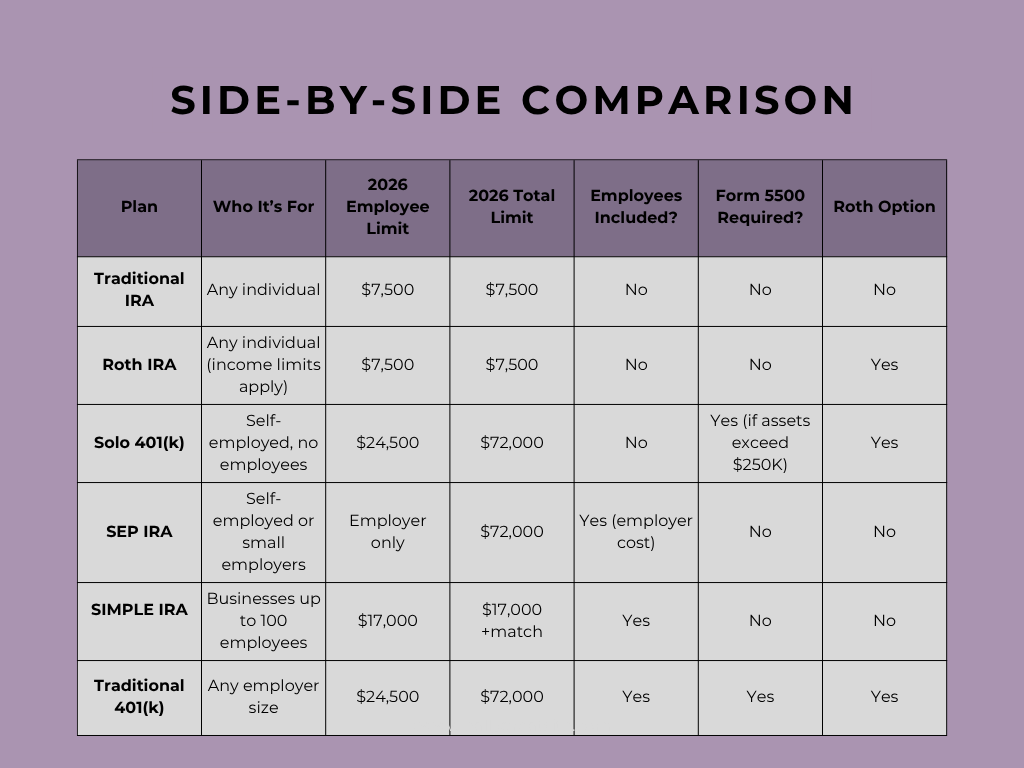
Which Plan Is Right for You?
Choosing the right retirement plan isn't one-size-fits-all. The best option depends on several factors:
Do you have employees? If yes, the SEP IRA's equal-contribution requirement, SIMPLE IRA's match structure, or traditional 401(k)'s flexibility all come into play. If no, a Solo 401(k) likely gives you the most firepower.
How much do you want to contribute? IRAs cap out at $7,500. Solo 401(k)s and SEP IRAs both reach $72,000.
How important is simplicity? SEP IRAs win on ease of administration. Traditional 401(k)s require the most ongoing work.
What's your income? High-earning sole proprietors often benefit most from a Solo 401(k)'s dual contribution structure. Lower-income years may favor a SEP IRA's flexibility.
Are you planning to hire? If you currently have a Solo 401(k) but plan to bring on W-2 employees, you'll need to transition to a different plan structure.
Work With a CPA Who Understands Small Business
Retirement planning and tax strategy go hand in hand. Every dollar you contribute to a pre-tax retirement account reduces your taxable income for the year — which means lower federal and Maryland state income taxes, and potentially lower self-employment taxes depending on the plan structure.
At Insightful Accounting Services, we help small business owners in Columbia, Maryland and throughout Howard County choose the right retirement plan, calculate optimal contribution amounts, and stay compliant with IRS filing requirements.
Whether you're just starting out and considering your first IRA, or you're a growing business ready to set up a SIMPLE IRA or 401(k) for your team, we're here to help you make the most of every dollar you've earned.